
Table of Contents
- Quick Comparison: Best Research Peptide Suppliers 2026
- How We Evaluated These Research Peptide Suppliers
- How to Verify Peptide Purity Before You Buy
- 1. HappyPeps: Verified U.S.-Sourced Research Peptides
- 2. Protide Health: Public CoA Library and Multi-Method Testing
- 3. Limitless Life: Consistent Batch Testing for Academic Labs
- 4. Biotech Peptides: Research-Grade Quality Control
- 5. Core Peptides: Transparent Purity Reporting
- 6. Limitless Biotech: Batch-Tested Research Materials
- Research Peptide Storage and Handling
- Frequently Asked Questions
Last Updated: September 10, 2026
Quick Comparison: Best Research Peptide Suppliers 2026
Finding the best research peptide suppliers 2026 means balancing purity verification, documentation quality, and shipping reliability against your lab’s budget. This guide breaks down six suppliers that meet modern analytical standards. The short answer: prioritize vendors who publish batch-specific Certificates of Analysis and test with both HPLC and mass spectrometry.
| Supplier | Testing Method | CoA Access | Best For |
|---|---|---|---|
| HappyPeps | Independent third-party, per batch | Public, downloadable | U.S.-sourced verified compounds |
| Protide Health | HPLC + LC-MS | Public library | Analytical data transparency |
| Limitless Life | HPLC + LC-MS | On request | Academic labs |
| Biotech Peptides | Third-party verification | Batch-specific docs | Documented purity levels |
| Core Peptides | QA purity reporting | Per product | Verified purity focus |
| Limitless Biotech | Batch concentration testing | Per product | Consistent research materials |
How We Evaluated These Research Peptide Suppliers
We scored each vendor on four criteria: third-party testing depth, CoA transparency, shipping reliability, and price-to-purity ratio. A supplier that skips independent verification fails regardless of catalog size.
Third-Party Testing and CoA Transparency
Third-party testing is the single most important differentiator. A Certificate of Analysis is a batch-specific document reporting purity, identity, and concentration from an independent lab (the FDA). Vendors who test in-house only, or who refuse to share CoAs before purchase, create avoidable risk for your research.
Shipping, Support, and Price-to-Purity Ratio
Cold chain logistics matter for lyophilized powder stability. Vendors with reliable fulfillment and responsive technical support reduce the chance your compounds degrade in transit. Price-to-purity ratio means comparing cost against verified purity, not headline price alone.
How to Verify Peptide Purity Before You Buy
Purity verification starts with three documents: a batch-specific CoA, an HPLC chromatogram, and a mass spectrometry confirmation. Request all three before ordering, and confirm the batch or lot number on the CoA matches the vial you actually receive. A generic sample report is not verification, it is marketing.
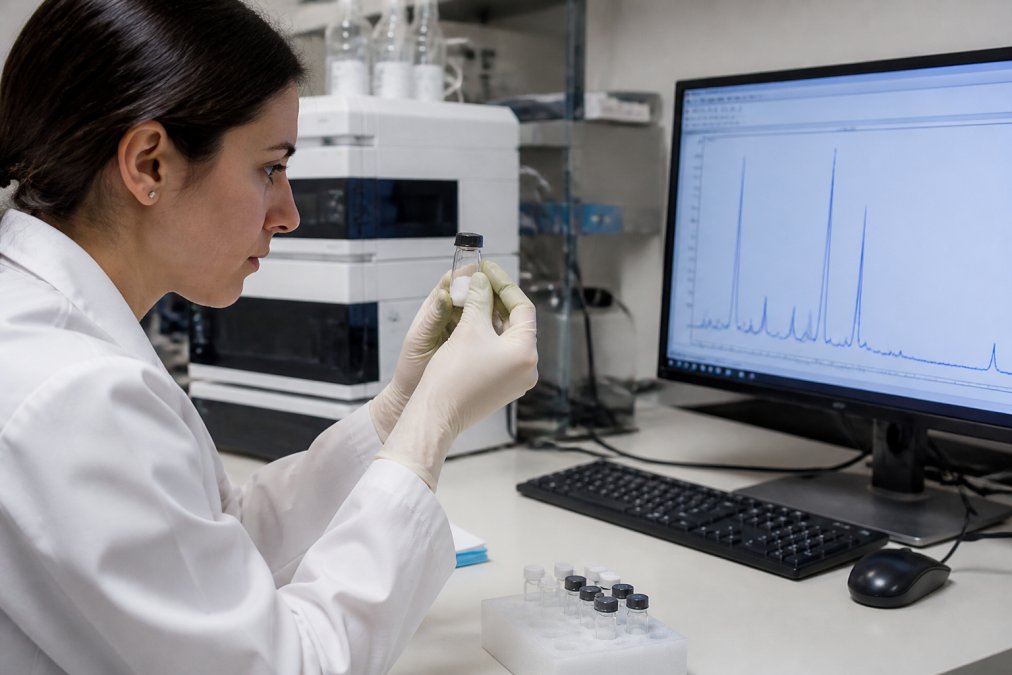
High-performance liquid chromatography (HPLC) separates compounds by retention time to quantify purity (peer-reviewed research). The main peak represents your target peptide; the area under that peak, divided by total peak area, produces the purity percentage. Read the chromatogram, not just the number. A clean result shows one dominant peak with a flat baseline. Warning signs include a broad or split main peak, a rising baseline (the “smiling” gradient artifact), or several unlabeled minor peaks that the report never identifies.
Liquid chromatography-mass spectrometry (LC-MS) confirms molecular weight and sequence integrity (PubMed). The reported mass should match the theoretical mass of the peptide sequence within normal instrument tolerance. A purity figure without a matching mass is an incomplete verification. Together the two methods catch what either misses alone: HPLC can miss a co-eluting impurity of similar retention time, and mass spectrometry alone cannot quantify how much of the sample is your target compound.
Understanding a certificate of analysis for peptides means reading the impurity profile, not just the purity percentage. A 98% purity figure with multiple unidentified peaks tells a different story than 98% with a clean single peak. Ask what the remaining percentage is, residual solvents, truncated sequences, counterions, or water content all behave differently in an assay.
Batch-specific verification protocol
Most guides stop at “request a CoA.” The step they skip is cross-referencing it. Use this sequence:
- Match the lot number. The batch or lot ID on the CoA must match the ID printed on your vial label. If the vendor sends a CoA for a different lot, the document does not apply to your material.
- Check the test date against the ship date. A CoA dated well before your order may describe an older batch. Confirm the testing date falls within the batch’s production window.
- Verify the testing lab. Independent labs are named on legitimate reports. Look up the lab and confirm it performs peptide analysis; an unnamed “third-party lab” is a red flag.
- Confirm the method is stated. The CoA should name the method (for example, RP-HPLC with a specified column and wavelength) rather than just reporting a percentage.
- Reconcile the math. Purity percentage, impurity peaks, and mass should be internally consistent. Numbers that do not add up suggest a templated or copied report.
Common red flags in CoA documentation
- A purity percentage with no chromatogram attached
- Identical peak areas or retention times across unrelated peptides
- A mass that does not match the stated sequence
- No lot number, or a lot number that changes between the quote and the shipment
- A CoA that lists only “99% purity” with no method, no lab, and no impurity data
If a supplier cannot produce a batch-specific CoA with a chromatogram and mass confirmation before purchase, treat the purity claim as unverified regardless of how the product page is worded.
1. HappyPeps: Verified U.S.-Sourced Research Peptides
HappyPeps is our top pick for laboratories that need documented, batch-specific verification without workflow disruption. Every batch ships with an independent third-party lab test and a downloadable Certificate of Analysis, so you can confirm identity, purity, and concentration before your compounds arrive.
What sets HappyPeps apart is the combination of U.S. sourcing, gated fulfillment, and accessible CoAs. You can review documentation before you commit, which answers the most common objection we hear: how do you know the data backs the claim?
- Independent third-party lab testing on every batch
- U.S. sourcing and fulfillment from a secure center
- Downloadable CoAs for all batches
- Secure, gated checkout process
The tradeoff: HappyPeps does not publish a public price list, so budget planning requires a quote. For labs prioritizing verified consistency over the lowest sticker price, that tradeoff is worth it.
2. Protide Health: Public CoA Library and Multi-Method Testing
Other providers run HPLC and LC-MS on every batch and maintain publicly accessible CoA libraries. If you want to audit a vendor’s testing history before contacting them, this is a transparent model. Pricing is not published for all items, which slows procurement.
3. Limitless Life: Consistent Batch Testing for Academic Labs
Other providers build their reputation on standardized testing protocols and a broad catalog of research-grade compounds. Academic labs with established supply chains tend to stick with them. Inventory availability fluctuates, so plan orders around restock cycles.
4. Biotech Peptides: Research-Grade Quality Control
Other providers focus on batch-specific purity documentation and secure shipping for sensitive materials. Their documentation is solid; their catalog is narrower than larger competitors, and they are strictly research-only.
5. Core Peptides: Transparent Purity Reporting
Other providers emphasize transparent purity reporting and responsive technical support. Pricing varies by compound complexity, so compare cost-per-milligram rather than list price when vetting them.
6. Limitless Biotech: Batch-Tested Research Materials
Other providers provide batch-tested concentration and purity data with a CoA for every product. They require research-use verification, which keeps their buyer pool qualified but adds a step to onboarding.
Research Peptide Storage and Handling
Research peptide storage and handling determines whether a verified compound stays verified. A CoA describes the material at the moment of testing; everything after that is on you. Degradation is driven by three variables, moisture, temperature, and mechanical stress, and controlling them preserves both purity and sequence integrity.
Lyophilized powder (before reconstitution)
Lyophilized powder should stay sealed, refrigerated, and protected from light until reconstitution. The freeze-dried cake is hygroscopic: every time the vial is opened at room temperature, ambient moisture condenses on the powder and accelerates hydrolysis. The practical fix is to let a refrigerated vial equilibrate to room temperature before opening it, so condensation forms on the glass rather than the peptide.
- Store sealed vials at refrigerator temperature, protected from light
- Equilibrate to room temperature before opening to avoid condensation
- Keep desiccant in the storage container if vials are handled frequently
- Avoid repeated temperature cycling; each cycle stresses the cake
Reconstitution
Choose the solvent based on the peptide’s solubility, not convenience. Many peptides dissolve readily in bacteriostatic water; others require a small amount of acetic acid or a dilute buffer to go into solution cleanly. A peptide that will not dissolve may be aggregating rather than degrading, and forcing it with heat or vigorous vortexing can damage the sequence. Add solvent down the vial wall, swirl gently, and give it time.
After reconstitution
Once reconstituted, follow the vendor’s stability guidance and avoid repeated freeze-thaw cycles, which degrade sequence integrity over time. If you must freeze aliquots, freeze them once, in single-use volumes, and thaw only what you need. Record the reconstitution date on the vial.
Shipping conditions and degradation
This is the variable most buyers never audit. A batch can leave the supplier at high purity and arrive degraded if it sat in a hot delivery truck or cleared customs over several days. Cold-chain packaging, insulated liners, and gel packs slow the temperature rise but do not eliminate it. When a shipment arrives:
- Inspect the packaging for evidence of heat exposure or a thawed cold pack.
- Confirm the vial lot number matches the CoA you were sent.
- Note the delivery date and any transit delays in your records.
If assay results drift on a batch that tested clean, transit exposure is a reasonable first suspect, ahead of the supplier’s testing.
Storing reconstituted peptides at room temperature for extended periods accelerates degradation. If your CoA reports high purity but your assay results drift, storage is the first variable to audit, followed by transit conditions.
Verification does not end at the CoA. Match the lot number, control moisture and temperature, reconstitute with the right solvent, and log transit conditions. Those four habits preserve the purity you paid for.
Frequently Asked Questions
Who is the best peptide vendor in 2026?
The best research peptide suppliers 2026 depends on your lab’s specific needs. HappyPeps stands out for U.S.-sourced materials with independent third-party lab testing and accessible Certificates of Analysis for every batch. Other providers offer public CoA libraries or custom synthesis for large-scale projects. Evaluate suppliers based on testing transparency, batch consistency, shipping reliability, and price-to-purity ratio rather than a single ranking.
How do I verify a Certificate of Analysis (CoA) for research peptides?
Start by checking that the CoA includes the batch number, test date, and methods used, such as HPLC and LC-MS. Look for purity percentages, molecular weight confirmation, and impurity profiles. Cross-reference the batch number on the vial with the CoA. Reputable suppliers, including HappyPeps, provide downloadable CoAs before purchase, so you can review analytical testing data before committing to an order.
What should I look for when learning how to verify peptide purity?
Focus on third-party testing documentation, not just supplier claims. Check for HPLC purity above 95%, LC-MS confirmation of molecular weight, and contaminant screening results. Request batch-specific data rather than generic reports. Suppliers that provide publicly accessible CoAs, including HappyPeps, make verification straightforward. Also confirm the testing lab is independent from the supplier to avoid biased results.
How should I handle research peptide storage and shipping concerns?
Lyophilized peptides should be stored at -20°C or lower, protected from light and moisture. Once reconstituted, aliquot to avoid repeated freeze-thaw cycles. For shipping, confirm the supplier uses cold chain logistics with insulated packaging and temperature monitoring. HappyPeps ships from a secure U.S. fulfillment center with reliable handling protocols. Always check the CoA for recommended storage conditions specific to each compound.
Are research peptide suppliers regulated in the United States?
Research peptides are not approved by the FDA for human consumption and are sold strictly for laboratory and in-vitro research. Suppliers operating legally must label products as research-grade and not make therapeutic claims. The regulatory landscape means researchers should verify that suppliers follow GMP-aligned manufacturing standards, provide third-party testing, and maintain supply chain transparency. Always confirm the supplier’s compliance documentation before purchasing.
Sourcing research peptides is a documentation problem before it is a pricing problem. HappyPeps addresses it directly with independent third-party testing on every batch, U.S. sourcing and fulfillment, downloadable Certificates of Analysis, and a secure gated checkout that keeps compliance intact. Start your next order with HappyPeps and get verified identity, purity, and concentration with every batch.